Course Science for Experts
This program is a collaboration between the University of Maryland’s NEARSPACE program (https://md.spacegrant.org/mdsgc-programs/balloon-payload-program/) and GISW. It is an exciting opportunity for students to participate in the emerging field of near and low earth orbit science.
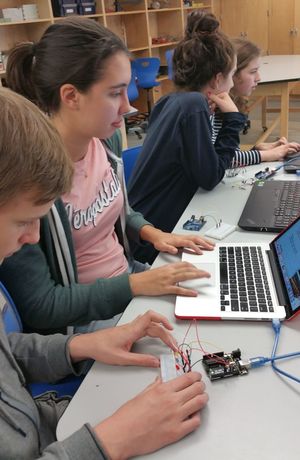
Students will build a custom payload with instruments that can take images and measure properties of the atmosphere as the payload ascends to an altitude of 100,000 ft via a weather balloon. To prepare for that task they have to achieve basic knowledge about sensors, measuring instruments and how to program Arduinos. Using the school’s weather bug station they will collect, analyze and compare data about weather conditions.
The completed payload will be tested by NEARSPACE and hopefully launched in spring. The gathered data will later be analyzed and provided to teachers for use in regular science classes.
This initial effort will be the basis for building knowledge capacity at GISW to pursue more ambitious projects that potentially include the launch of pico-satellites from rockets mounted on high altitude balloons. Small satellite platforms are an emerging technology for the utilization of space. The largest cost to deploy a satellite is getting it to low Earth orbit. The use of balloons cuts the cost substantially. A program of this type will provide a broad range of training spanning, space science, engineering and information science/technology.
Articles:
Article from Dr. Lampkin “GISW airspace initiative”
Article from Wolf Hassler “Join the Science for Experts” AG